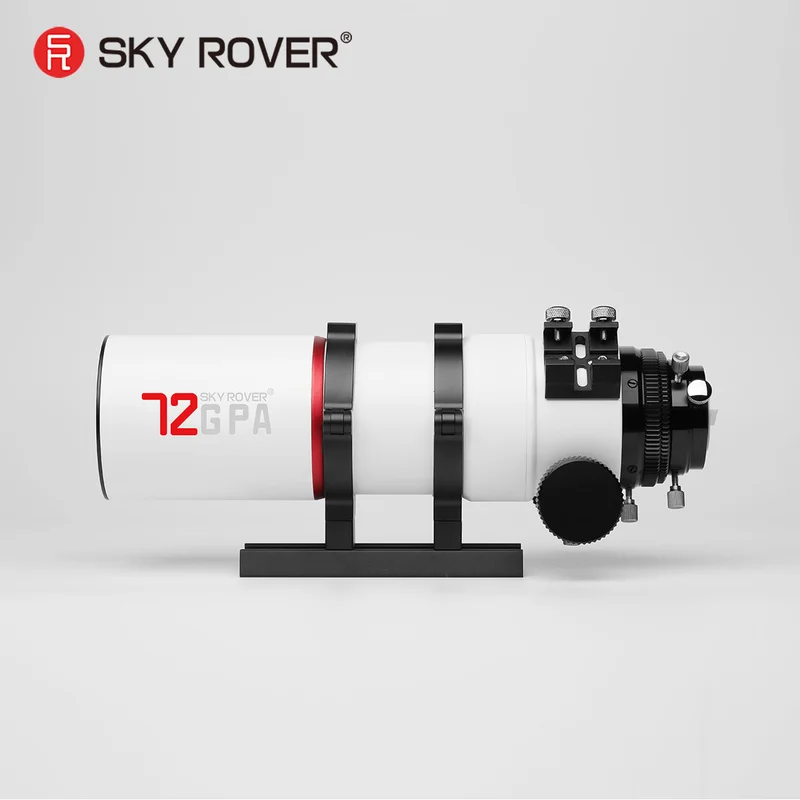
Description
Visually, the 72 GPA is a rich-field instrument. At 18 with a 24mm eyepiece, you get a wide true field perfect for sweeping the Milky Way, scanning star clouds in Sagittarius, or taking in the full extent of large open clusters like the Beehive (M44) or the Double Cluster in Perseus. The Pleiades sit in the field with nebulosity hinted at under dark skies. The Orion Nebula shows its characteristic shape with the Trapezium cluster resolved. M31 stretches across the field with its dust lanes becoming visible as your eye adapts. Jupiter shows two equatorial bands, the Galilean moons, and hints of detail in the belts on steady nights. Saturn’s rings are unmistakable, with the Cassini Division visible at 6070 under good conditions. The Moon is a showpiece at any magnification this scope can deliver the Super ED doublet produces a clean, crisp lunar image without the color fringing that plagues lesser optics.
As an imaging scope, the 72 GPA is in its element. At 432mm on an APS-C sensor, you can frame the entire Orion Nebula complex including the Running Man, both companions of M31 in a single shot, the California Nebula nearly full-frame, and sweeping mosaics of the Milky Way’s richest regions. On a full-frame sensor with the 1 flattener, the Veil Nebula complex fits in a single exposure, and large hydrogen-alpha regions like the Heart and Soul nebulae become single-frame targets. The f/6 speed means each sub-exposure collects light efficiently, and the 432mm focal length is forgiving of guiding imperfections making this an ideal scope for imaging from a star tracker or a lightweight mount.
For EAA users, the 72 GPA paired with a camera and live-stacking software brings faint objects to the screen in real time. The 44% increase in light grasp over a 60mm means faster stacking times and more visible detail galaxies and nebulae appear within minutes rather than requiring extended integration.
Observing Tip
The 72 GPA’s Arca-compatible tube rings make it a natural pairing with a camera gimbal head for terrestrial use during the day. If you’re carrying this scope on a dark-sky vacation, use it for birding and nature observation in the daytime and astronomy at night no need to pack a separate spotting scope. At 432mm and f/6, it delivers sharp, bright terrestrial views that rival dedicated spotting scopes at comparable focal lengths, and the 2.5-inch focuser handles the weight of a camera body comfortably. When the sun goes down, swap the camera for an eyepiece and diagonal, and you’re ready for the sky.
Frequently Asked Questions
How does the 72 GPA compare to the 60 GPA?
The 72 GPA collects 44% more light, has a longer focal length (432mm vs. 360mm) for better image scale on smaller targets, and ships with a larger 2.5-inch focuser that handles heavier camera payloads with more stability. The 60 GPA is lighter and more compact for pure travel, but the 72 GPA is the better all-around performer for imaging and visual observing. If you can accommodate the modest increase in size and weight, the 72mm aperture pays dividends.
Is this a good astrophotography scope?
It’s an excellent one. The 432mm focal length at f/6 is fast enough for efficient light gathering, forgiving of tracking errors, and long enough to produce good image scale on popular targets. The 2.5-inch focuser with CAA provides mechanical stability that cheaper 72mm scopes lack. And the optional 1 flattener delivers flat fields across full-frame sensors. This is a serious imaging platform in a portable package.
What mount or tracker do I need?
For imaging, any star tracker handles the 72 GPA easily the iOptron SkyGuider Pro, Sky-Watcher Star Adventurer, or similar. For autoguided imaging, a small German equatorial mount like the iOptron GEM28 or Sky-Watcher HEQ5 provides more than enough capacity. For visual use, a sturdy photo tripod works well. The total system weight of about 5.5 pounds puts it well within the payload limits of virtually any portable mount or tracker.
Does the 1 flattener really cover full-frame?
Yes. Sky Rover rates the 72 GPA’s dedicated flattener for full-frame coverage. At 432mm on a full-frame sensor, you’ll see sharp, round stars across the vast majority of the frame. Dedicated CMOS and CCD astronomy cameras with 48mm T-threads connect directly to the flattener’s M48 output; DSLR and mirrorless cameras connect via a T-ring for your specific mount (sold separately).
Can I use this scope for terrestrial observation?
Absolutely. At 432mm and f/6, the 72 GPA works as a high-quality spotting optic for birding, wildlife, and nature observation. The Arca-compatible tube rings mount directly to a camera gimbal head. The 2.5-inch focuser handles camera bodies comfortably. Use it with an eyepiece and diagonal for direct observation, or attach a camera for long-range terrestrial photography. It’s a genuinely multi-purpose optic.
Recommended Accessories
- Sky Rover 1 Flattener for 72 GPA (SR72GPAFF): Threads onto the CAA’s M48 output. Corrects field curvature for full-frame coverage. Transforms the 72 GPA from a visual/planetary scope into a complete widefield imaging system.
- Sky Rover 2″ Diagonal (SR2D): Full 2-inch light path for wide-field visual observing. Pairs with the 2.5-inch focuser for maximum field of view.
- Sky Rover UWA 7mm Eyepiece: At 432mm focal length, the 7mm delivers 62 a solid magnification for lunar detail, planetary observation, and tighter deep-sky targets like planetary nebulae and globular clusters.
- Sky Rover UF 24mm Eyepiece: Delivers 18 with a wide true field for rich-field sweeping. The ideal low-power visual companion for this scope.
Final Thoughts
The 72 GPA hits the aperture sweet spot where portability and capability genuinely overlap. It’s not just a bigger version of the 60 GPA the 44% increase in light grasp, the oversized 2.5-inch focuser, and the full-frame imaging capability make it a meaningfully more capable instrument. Yet it’s still light enough for a star tracker and compact enough for a carry-on bag. If you need one scope that handles widefield astrophotography, casual visual observing, daytime terrestrial use, and dark-sky travel and handles all of them well the 72 GPA is the size where those worlds converge.
Tech Details:
| Brand | Sky Rover |
| Model | 72 GPA (General Purpose Air Series) |
| Aperture | 72mm (2.8″) |
| Focal Length | 432mm |
| Focal Ratio | f/6 |
| Optical Design | Air-spaced Super ED doublet apochromat |
| Glass Type | Super ED (FCD-100) |
| Optical Coatings | Fully multi-coated (FMC) all air-to-glass surfaces |
| Focuser Type | 2.5″ dual-speed rack-and-pinion with integrated CAA |
| CAA Thread | M480.75 |
| Focuser Travel | ~94mm |
| Dew Shield | Retractable |
| Tube Material | Aluminum alloy |
| Min. Length (retracted) | ~12″ (~310mm) |
| Max. Length (extended) | ~15″ (~380mm) |
| OTA Weight | Under ~4.4 lbs (under 2 kg) |
| Total Weight (with rings & dovetail) | ~5.5 lbs (~2.5 kg) |
| Mounting System | Dual tube rings (Arca-compatible) + Vixen dovetail plate |
| Included Adapter | 2″ to 1.25″ eyepiece adapter |
| Flattener Backfocus | 178.8mm total (with optional 1 flattener) |
| Lens Cell Engraving | D=72MM F/6 SUPER ED DOUBLET APO FMC + serial number |
| Packaging | Pearl cotton protective packaging, double-layer cartons |
Reviews
There are no reviews yet.