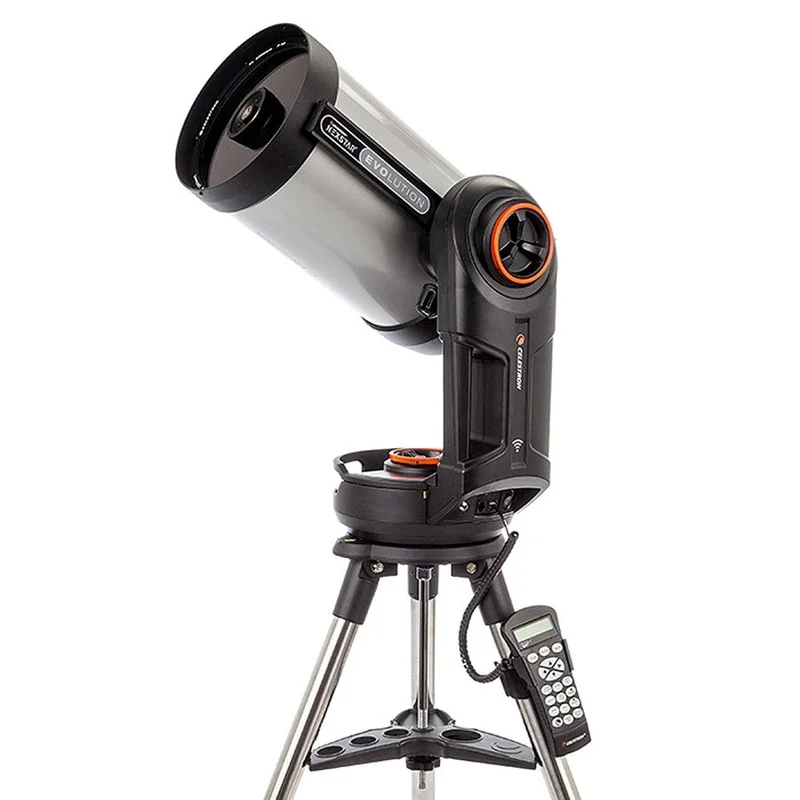
Description
Budget 4045 minutes for cool-down when moving the C8 from a warm interior to a cold night. The 8-inch corrector plate holds thermal mass longer than youd expect, and planetary images will noticeably improve after the tube has equilibrated. To speed this up, remove the rear cap while cooling air circulation through the tube from back to front reduces thermal settling time. If youre doing a pure planetary session, use a 1.25 eyepiece path rather than a 2 diagonal to minimize the length of the back-focus train. For the best results at high magnification, wait for the image of a star to settle to a steady, sharp point before calling the seeing poor the first 10 minutes after full cool-down often reveal significantly better seeing than the initial view suggests.
Final Thoughts
The C8 is not a compromise. After 50 years of continuous production, its optics, its accessories, and its reputation are fully developed. The Evolution mount was designed around this optical tube the balance is right, the stability is right, and the accessory ecosystem that grew up around the C8 over five decades is available to you immediately. If youre comparing the Evolution 8 to something more expensive, the question worth asking is: how often will you actually observe? A scope that gets used beats a better scope that stays in the garage.
Frequently Asked Questions
Is the C8 better than the C9.25 for visual observing? For most observers on most nights, yes in the sense that the C8 is a better match for the Evolution mount. The 9.25 gathers 34% more light and resolves more detail in principle, but it sits at the upper limit of what the single-arm fork handles comfortably. The C8 is comfortably within the mounts design range, which means better stability and faster vibration damping. The net high-power observing experience where seeing is usually the limiting factor often favors the well-mounted 8 over the larger 9.25. For strictly aperture-limited work (very faint objects, maximum resolution on tight doubles), the 9.25 has a real edge.
Can I use the C8 for astrophotography without a wedge? For planetary and lunar imaging yes, no wedge needed. The Alt-Az tracking handles the short exposures that planetary cameras use. For long-exposure deep sky work, an equatorial wedge is required to enable the EQ tracking modes and prevent field rotation. With the wedge and a guiding setup, exposures of 12 minutes per frame are practical. The Hyperstar/Fastar f/2 conversion enables much shorter exposures in Alt-Az mode, which partially sidesteps the field rotation issue for wide-field targets.
How does the NexStar Evolution 8 compare to the NexStar 8SE? Both use the C8 optical tube with StarBright XLT coatings. The Evolution 8 adds the built-in LiFePO4 battery (no external power needed), integrated WiFi (SkyPortal app control), and a manual clutch on the fork arm. The SE is a solid scope at a lower price point. The Evolution package is worth the upgrade if you value the battery convenience, app control, and improved stability.
Does the CG-5 dovetail on the C8 work with other mounts? Yes. The CG-5 dovetail bar is a standard Celestron format compatible with CG-5, AVX, CGX, and other saddle plates that accept the CG-5 standard. The C8 optical tube can be moved to an equatorial mount later if your imaging ambitions grow beyond what the single-arm fork provides the OTA investment is not locked to this mount.
Tech Details:
| Optical Tube | |
| Optical Design | Schmidt-Cassegrain |
| Aperture | 203mm (8) |
| Focal Length | 2032mm (80) |
| Focal Ratio | f/10 |
| Highest Useful Magnification | 480x |
| Lowest Useful Magnification | 29x |
| Limiting Stellar Magnitude | 14.0 |
| Resolution (Rayleigh) | 0.69 arc seconds |
| Resolution (Dawes) | 0.57 arc seconds |
| Light Gathering Power | 843x (vs. unaided eye) |
| Secondary Mirror Obstruction | 64mm (2.5) 31% by diameter, 10% by area |
| Optical Coatings | StarBright XLT |
| Optical Tube Material | Aluminum |
| Optical Tube Length | 432mm (17) |
| Optical Tube Diameter | 238mm (9.37) |
| Optical Tube Weight | 13 lbs (5.9 kg) |
| Total Kit Weight | 40.6 lbs (18.5 kg) |
| Dovetail | CG-5 dovetail bar |
| Included Eyepieces | 40mm Plssl (51x) and 13mm Plssl (156x), 1.25 |
| Finder | Red dot finderscope |
| Diagonal | 1.25 star diagonal |
| Mount, Tripod & Electronics | |
| Mount Type | Computerized Alt-Az Single Fork Arm |
| Instrument Load Capacity | 25 lbs (11 kg) |
| Height Range | 1244.61651mm (4965) |
| Tripod Leg Diameter | 50.8mm (2) stainless steel |
| Slew Speeds | 9 speeds max 4/second |
| Tracking Rates | Sidereal, Solar, Lunar |
| Tracking Modes | Alt-Az, EQ North, EQ South (EQ requires optional wedge) |
| Motor Drive | DC servo motors with brass worm gears |
| Alignment Procedures | SkyAlign, 1-Star, 2-Star, Auto 2-Star, Solar System, Quick-Align, Last Alignment, EQ North/South |
| NexStar+ Database | Over 40,000 objects |
| Auxiliary Ports | 4 AUX ports (hand control works from any port) |
| USB Port | Yes hand control input and mount output |
| WiFi | Built-in (SkyPortal app compatible) |
| Battery | Internal 9-cell 6V 4.5Ah LiFePO4 up to 10 hours |
| Power Input | AC adapter, 12V DC, or USB (included 4-plug AC adapter) |
| Hand Controller | NexStar+ 2-line 18-char backlit LCD, 19 LED buttons, USB 2.0 |
| Periodic Error Correction | No |
| Autoguide Port | No |
| Dovetail Compatibility | CG-5 saddle plate |
| Software | Celestron Starry Night Special Edition + SkyPortal app |
Reviews
There are no reviews yet.