Description
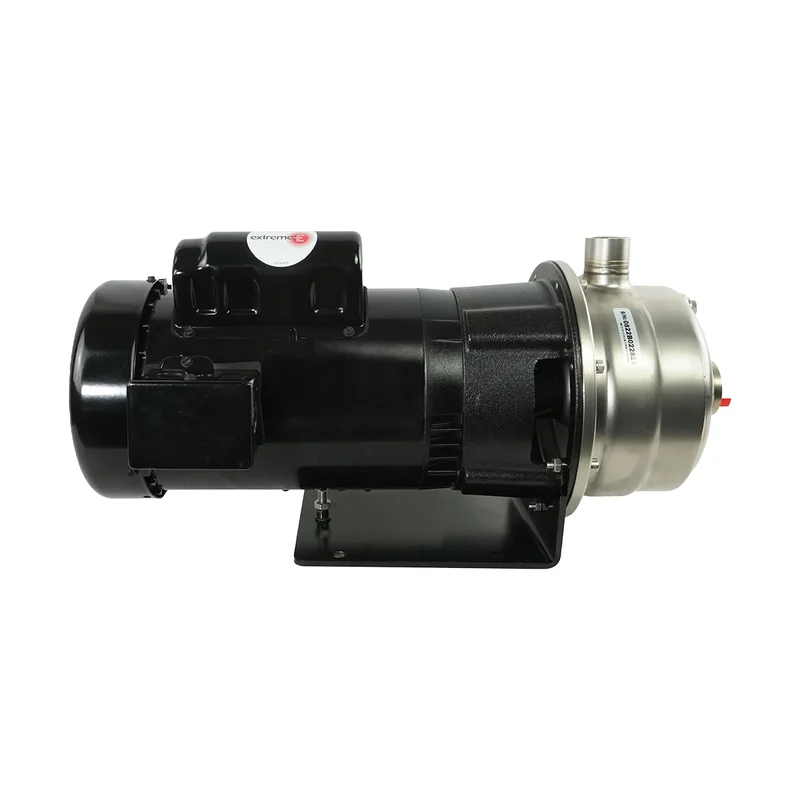
Centrifugal 2-Stage Pump
The Centrifugal 2-Stage Pump is a two-stage, high-head stainless steel centrifugal pump designed for industrial, commercial, and agricultural applications. Delivering up to 65 GPM and pressures reaching 107 PSI, its ideal for systems requiring smooth, continuous-duty performance. The pumps close-coupled design and 304 stainless steel construction ensure reliability, efficiency, and ease of maintenance in demanding environments.
Ideal Applications:
- Deionized water systems
- Reverse osmosis systems
- Distribution and circulation systems
- Car washes and cooling tower systems
- Pre-filter charge and liquid transfer systems
Experience unmatched quality and performance with the Centrifugal 2-Stage Pump. Built to handle your toughest challenges with reliability and ease.
###
Centrifugal 2-Stage Pump
Cast Iron / Stainless Steel 50 GPM 2 Stage 3 HP / 3 Phase
| Technical Specifications | |
|---|---|
| Model | Centrifugal 2-Stage Pump |
| Nominal Flow Rate | 50 GPM |
| Stages | 2 |
| Motor RPM | 3500 RPM |
| HP Rating | 3 HP |
| Phase / Hertz | 3 PH / 60 Hz |
| Suction / Discharge | 1 NPTF / 1 NPTF |
| App. Dimensions (L x W x H) | 14.9 x 8.1 x 9.0 |
| App. Weight (lb) | 35 |
###
###
Centrifugal 2-Stage Pump Installation Manual
Installation Instructions
- Preparation:
- Ensure the pump is undamaged and all parts are present.
- Confirm that the motor voltage matches the power supply.
- Check alignment of the pump and motor before installation.
- Foundation:
- Mount the pump on a flat, stable, and vibration-free surface.
- Use anchor bolts to secure the pump if necessary.
- Pipe Connections:
- Attach suction and discharge pipes to the pump using appropriate gaskets and seals.
- Ensure the suction pipe is free of leaks and has proper support to avoid strain on the pump.
- Install a check valve and isolation valve on the discharge side.
- Priming the Pump:
- Fill the pump casing with liquid to ensure it is primed before starting.
- Use a vent valve to remove air from the pump casing.
- Electrical Wiring:
- Connect the motor to the power supply following local electrical codes and standards.
- Ensure the motor is properly grounded.
- Verify motor rotation matches the direction indicated on the pump casing.
- Startup:
- Open the suction and discharge valves.
- Start the motor and observe the operation.
- Check for leaks, unusual noise, or vibrations.
- Final Adjustments:
- Adjust flow and pressure as needed using the discharge valve.
- Avoid throttling the suction side to maintain pump efficiency.
- Regular Maintenance:
- Periodically inspect the pump and motor for wear or damage.
- Lubricate bearings as per the manufacturers recommendations.
Reviews
There are no reviews yet.