Description
k Airy patterns tight central disks with well-defined diffraction rings that make close doubles easier to resolve than they’d be in an obstructed telescope of equal aperture.
For deep-sky work, the step up to 102mm is where globular clusters start to truly resolve. M13 shows individual stars across its face under moderate magnification and dark skies. M5 and M3 granulate into pinpoints. Planetary nebulae M57, M27, NGC 7662 reveal shape, color, and edge definition. Open clusters like the Double Cluster, M35, and M37 are rich sprays of pinpoint stars. Under dark skies, you’ll see spiral arm structure in M51 and brightness variations in M101. The Orion Nebula is a showpiece: wings, tendrils, the central Trapezium cluster resolved, and the darker nebulosity that frames the bright core all visible with direct vision.
For astrophotography, 714mm at f/7 on an APS-C sensor gives you a field of view that frames individual galaxies and nebulae with good image scale. M31 fills the long axis of the frame. The Rosette Nebula fits with context. M33 shows face-on spiral detail. The focal length is long enough to produce satisfying image scale but short enough to be forgiving of mount imperfections. With the 1 flattener, the 102 GPA becomes a solid imaging platform for broadband and narrowband deep-sky work.
Observing Tip
A 102mm doublet has more glass mass than the smaller GPA scopes, and it takes longer to reach thermal equilibrium. Plan for 2030 minutes of cool-down after you set up. Start the session at moderate magnification 50 to 80 on easy targets while the objective stabilizes. By the time you’ve worked through a few star clusters or scanned the Moon at low power, the scope will be ready for higher magnifications on planets. On a good night, the 102 GPA will happily take 200 or more on Jupiter and Saturn. Use a planetary filter a #80A light blue on Jupiter brings out belt detail, and a #23A light red on Mars enhances the dark markings. Small accessories, big results.
Frequently Asked Questions
How does the 102 GPA compare to the 102 GPA Planetary (f/11)?
They’re two very different scopes built around the same aperture. The 102 GPA at f/7 is a general-purpose instrument versatile for visual observing, deep-sky, and astrophotography with a shorter tube and wider field. The 102 GPA Planetary at f/11 is a dedicated visual specialist long focal ratio optimized for planetary contrast and chromatic correction, with a vintage-inspired design and no CAA option. If you want one scope that does everything, the f/7 is the choice. If planetary and lunar observing is your primary passion and you want the absolute best color correction from a doublet, the f/11 is purpose-built for that.
Why doesn’t the 102 GPA include a CAA like the 60 and 72 GPA?
The smaller GPA scopes are primarily imaging instruments where a CAA is nearly essential for framing. The 102 GPA serves a broader audience many buyers will use it primarily or exclusively for visual observing, where a CAA isn’t needed. Making the CAA optional keeps the base configuration focused and the price accessible.
What mount do I need?
The total system weight of about 9.3 pounds (4.2 kg) works well on mid-range German equatorial mounts. For visual use, the iOptron CEM26, Sky-Watcher EQ5, or a quality alt-az mount handles it comfortably. For imaging, the iOptron GEM28, Sky-Watcher HEQ5, or Celestron AVX provides solid performance at 714mm focal length. A star tracker can handle it for short exposures, though a full equatorial mount is recommended for guided imaging sessions.
Is there a dedicated flattener for this scope?
Yes a 1 field flattener is available as part of the photography package (sold separately). It corrects field curvature for flat, round stars across the camera sensor. Check with us for current availability and pricing.
How does the color correction compare to a triplet APO?
At f/7, a well-made Super ED doublet corrects chromatic aberration to a degree that most visual observers cannot distinguish from a triplet at the eyepiece. On the very brightest stars, you might detect a faint whisper of color at extreme magnifications if you’re specifically looking for it. Under real observing conditions, the difference between this doublet and a quality triplet is subtle. The triplet may have a slight advantage for wide-field imaging with a flattener. For visual work and planetary observation, the 102 GPA’s color correction is excellent.
Recommended Accessories
- Sky Rover 1 Field Flattener: Corrects field curvature for astrophotography. Delivers round, finely defined stars across the camera sensor. Essential for deep-sky imaging.
- Sky Rover 2″ Diagonal (SR2D): Full 2-inch light path for wide-field visual observing. A quality diagonal is essential for comfortable use.
- Sky Rover XWA 7mm Eyepiece: 100 apparent field at 102 the perfect planetary magnification in a four-inch scope. Immersive views of Jupiter, Saturn, and the Moon.
- Sky Rover UWA 16mm Eyepiece: 82 apparent field at 45 ideal for deep-sky sweeping, star clusters, and large nebulae.
- Sky Rover UF 24mm Eyepiece: Delivers 30 for wide-field views and target finding.
Final Thoughts
The 102 GPA is the scope where the GPA line becomes a serious telescope. Four inches of Super ED aperture resolves planetary detail, splits double stars, and gathers enough light that deep-sky objects show real structure. The f/7 ratio lets the doublet do its best chromatic correction work while keeping the tube manageable and the field of view wide. At under 10 pounds, it’s still a scope that one person sets up in minutes no observatory required, no help needed. For the observer who has outgrown an 80mm and wants more aperture without the weight and complexity of a triplet, the 102 GPA delivers the performance where it matters: at the eyepiece, under the sky, on a Tuesday night when you almost didn’t go out.
Tech Details:
| Brand | Sky Rover |
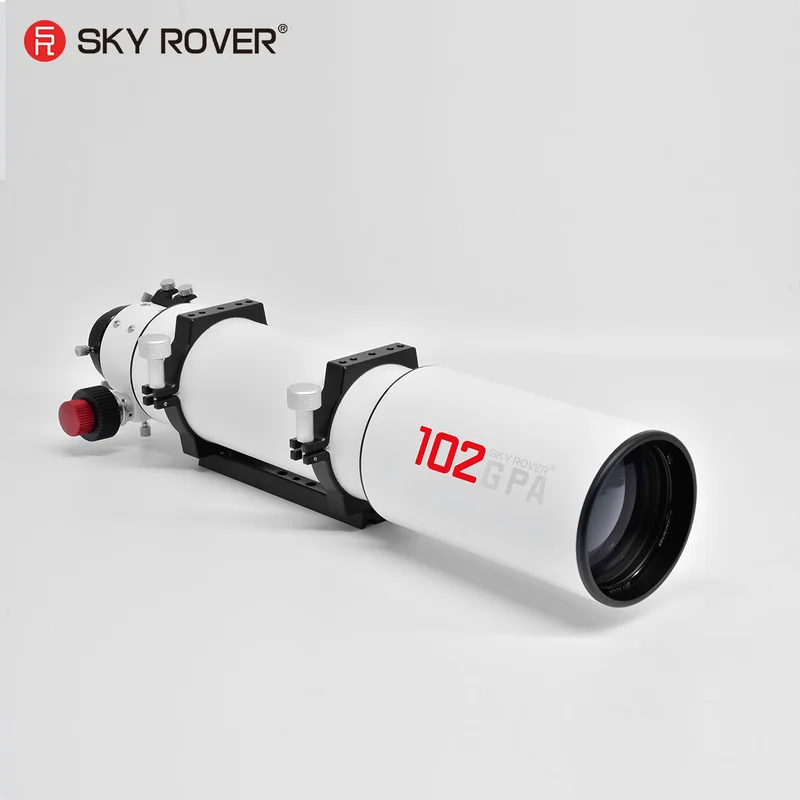
| Model | 102 GPA (General Purpose Air Series) |
| Aperture | 102mm (4.0″) |
| Focal Length | 714mm |
| Focal Ratio | f/7 |
| Optical Design | Air-spaced Super ED doublet apochromat |
| Glass Type | Super ED (FCD-100) |
| Optical Coatings | Fully multi-coated (FMC) all air-to-glass surfaces |
| Focuser Type | 2.5″ dual-speed rack-and-pinion |
| Focuser Travel | ~90mm |
| CAA | Optional (sold separately) |
| Dew Shield | Retractable |
| Tube Material | Aluminum alloy |
| Length (retracted) | ~23″ (~580mm) |
| Total Weight (with rings & dovetail) | ~9.3 lbs (4.2 kg) |
| Mounting System | Dual tube rings + Vixen dovetail plate |
| Theoretical Resolution | ~1.14 arcseconds |
| Styling | 2022+ red logo, red anodized focuser handwheels |
| Packaging | Pearl cotton protective packaging, double-layer cartons |
Reviews
There are no reviews yet.