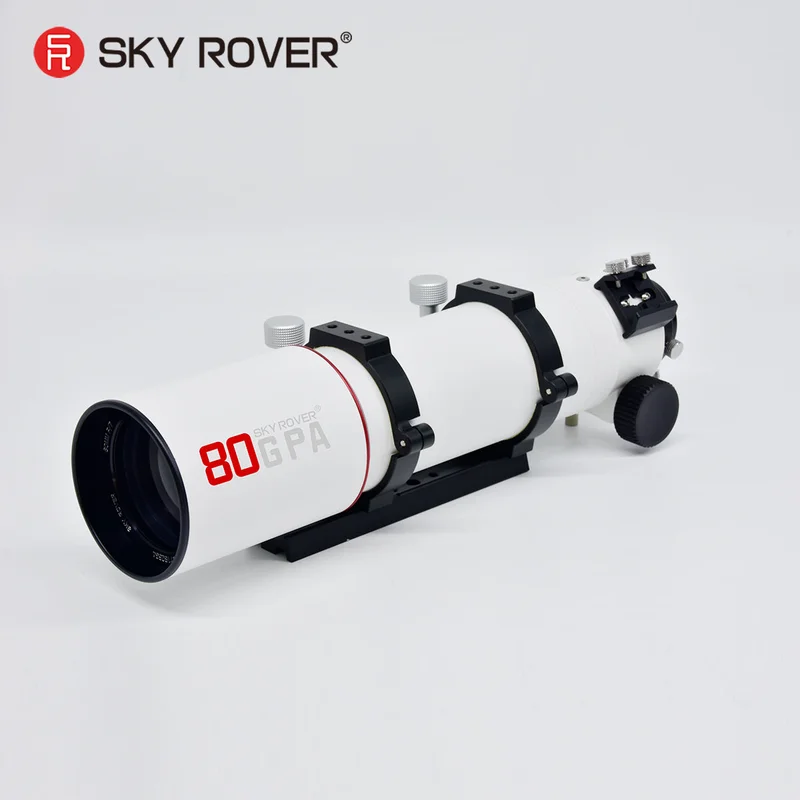
Description
For deep-sky, the 80 GPA shows M13 and M5 as granular balls of light that start to hint at individual stars under dark skies and moderate magnification. M57 (the Ring Nebula) is a distinct smoke ring. M27 (the Dumbbell) shows its characteristic shape with good contrast. The Orion Nebula is rich with detail the wings, the central Trapezium, and hints of the darker nebulosity surrounding M42. Open clusters like M35, M37, and the Double Cluster are stunning in the wide field that a 560mm refractor provides.
For astrophotography, the 560mm focal length at f/7 is a versatile platform. It provides good image scale for moderately sized targets galaxies like M31 and M33, nebulae like the Rosette and Lagoon, and star clusters throughout the Milky Way. The short focal length is forgiving of tracking imperfections, and the moderate speed keeps exposure times reasonable. A dedicated astronomy camera on the 80 GPA with a tracker produces genuinely impressive results for a scope this portable.
Observing Tip
At 560mm focal length, the 80 GPA pairs naturally with a wide-field eyepiece for deep-sky sweeping. A 24mm eyepiece gives you 23 with a true field of roughly 2.5 degrees enough to frame the Pleiades, the Hyades core, or an entire segment of a rich Milky Way star field. But don’t stop there. Bump up to a 7mm eyepiece for 80 and point it at Jupiter or the Moon you’ll be surprised by how much detail 80mm shows when the seeing cooperates. The key is thermal equilibrium: give the objective 1520 minutes after setup to match the ambient temperature. The doublet lens cell is thick enough that rushing this step costs you sharpness at higher powers. A small desk fan pointed at the objective cell during cool-down can cut the wait time in half.
Frequently Asked Questions
How does the 80 GPA compare to the 72 GPA?
The 80 GPA has 23% more light-gathering area and a longer focal length (560mm vs. 432mm), which means better image scale for planetary viewing and moderately sized deep-sky targets. The trade-off is slightly more weight (6.8 lbs vs. 5.5 lbs) and a slower focal ratio (f/7 vs. f/6), which means longer imaging exposures per frame. If portability is your top priority and you want the fastest possible speed for widefield imaging, the 72 GPA has the edge. If you want more aperture and a more versatile focal length for both visual and imaging, the 80 GPA is the better all-around choice.
Is this a good astrophotography scope?
Yes. The 560mm focal length at f/7 works well for a wide range of targets, and the 2.5-inch focuser provides solid mechanical support for camera payloads. The focal length is forgiving of tracking errors a key advantage for beginners. For deep-sky imaging on an APS-C sensor, you’ll get approximately 2.3 1.5 of sky per frame. Pair it with a star tracker or a small equatorial mount for excellent portable imaging results.
What mount do I need?
The total system weight of about 6.8 pounds (3.1 kg) is well within the capacity of mid-range star trackers and small equatorial mounts. For visual use, a sturdy alt-az mount or photo tripod with a fluid head works well. For imaging any small GEM like the iOptron GEM28 handles the 80 GPA easily. The low weight and moderate focal length make it an undemanding payload for almost any mount in its class.
Can I use this scope for daytime observation birding, wildlife, nature?
Absolutely. At 560mm focal length, the 80 GPA works as a high-quality long-focal-length optic for terrestrial subjects. The fully multi-coated Super ED doublet delivers sharp, high-contrast images with accurate color. Add a 2″ diagonal and an eyepiece for direct observation, or attach a camera for long-range photography. The dual tube rings mount to standard dovetail plates and can be adapted to camera gimbal heads.
Recommended Accessories
- Sky Rover 2″ Diagonal (SR2D): Essential for comfortable visual observing. The 2″ size passes the full light cone for wide-field eyepieces.
- Sky Rover UWA 7mm Eyepiece: At 560mm, the 7mm delivers 80 the sweet spot for planetary detail, bright globular clusters, and tight double stars.
- Sky Rover UF 24mm Eyepiece: Delivers 23 for wide-field sweeping. Ideal for star clouds, open clusters, and Milky Way scanning.
- Sky Rover XWA 13mm Eyepiece: 100 apparent field at 43 an immersive view for deep-sky objects and star fields. The wide field makes finding targets easy and the observing experience genuinely engaging.
Final Thoughts
The 80 GPA occupies the sweet spot where a telescope becomes truly useful without becoming burdensome. Eighty millimeters of Super ED apochromatic aperture resolves real detail on planets, splits genuine double stars, and shows deep-sky objects with enough light grasp that observing sessions feel rewarding rather than aspirational. The f/7 ratio lets the doublet do its best work clean, color-free images that the eyepiece and the camera both appreciate. At under 7 pounds, it’s a scope you’ll set up on weeknights, take on road trips, and reach for when the sky clears unexpectedly. That’s the telescope that teaches you the sky.
Tech Details:
| Brand | Sky Rover |
| Model | 80 GPA (General Purpose Air Series) |
| Aperture | 80mm (3.1″) |
| Focal Length | 560mm |
| Focal Ratio | f/7 |
| Optical Design | Air-spaced Super ED doublet apochromat |
| Glass Type | Super ED (FCD-100) |
| Optical Coatings | Fully multi-coated (FMC) all air-to-glass surfaces |
| Focuser Type | 2.5″ dual-speed rack-and-pinion |
| Dew Shield | Retractable |
| Tube Material | Aluminum alloy |
| Length (retracted) | ~17″ (~425mm) |
| OTA Weight | ~4.4 lbs (~2 kg) |
| Total Weight (with rings & dovetail) | ~6.8 lbs (~3.1 kg) |
| Mounting System | Dual tube rings + dovetail plate |
| Theoretical Resolution | 1.45 arcseconds |
| Limiting Magnitude | 11.3 mag |
| Light-Gathering Power | 131 unaided eye |
| Packaging | Pearl cotton protective packaging, double-layer cartons |
Reviews
There are no reviews yet.